Uses
The RFID tag can be affixed to an object and used to track and manage inventory, assets, people, etc. For example, it can be affixed to cars, computer equipment, books, mobile phones, etc.RFID offers advantages over manual systems or use of bar codes. The tag can be read if passed near a reader, even if it is covered by the object or not visible. The tag can be read inside a case, carton, box or other container, and unlike barcodes, RFID tags can be read hundreds at a time. Bar codes can only be read one at a time using current devices.
In 2011, the cost of passive tags started at US$0.09 each; special tags, meant to be mounted on metal or withstand gamma sterilization, can go up to US$5.
Active tags for tracking containers, medical assets, or monitoring environmental conditions in data centers start at US$50 and can go up over US$100 each.
Battery Assisted Passive (BAP) tags are in the US$3–10 range and also have sensor capability like temperature and humidity.
RFID can be used in a variety of applications, such as:
- Access management
- Tracking of goods
- Tracking of persons and animals
- Toll collection and contact less payment
- Machine readable travel documents
- Smart-dust (for massively distributed sensor networks)
- Tracking sports memorabilia to verify authenticity
- Airport baggage tracking logistics
The adoption of these standards were driven by EPCglobal, a joint venture between GS1 and GS1 US, which were responsible for driving global adoption of the bar code in the 1970s and 1980s.
The EPCglobal Network was developed by the Auto-ID Center, an academic research project headquartered at the Massachusetts Institute of Technology (MIT) with labs at five leading research universities around the globe: Cambridge, Adelaide, Keio, Shanghai, Fudan, St. Gallen. At RFID Journal Live 2010 in Orlando, Airbus detailed 16 active projects, IBM and—most recently added to the team—CSC.
The two other areas of significant use are financial services for IT asset tracking and healthcare. RFID is becoming increasingly prevalent as the price of the technology decreases.
Commerce
The value of the RFID market in 2012 has become $7.46 (USD) billion versus $6.37 (USD) billion in 2011. The RFID world market is estimated to surpass $20 billion (USD) by 2014.Payment by mobile phones
Since summer 2009, two credit card companies have been working with Dallas, Texas-based Device Fidelity to develop specialized microSD cards. When inserted into a mobile phone, the microSD card can be both a passive tag and an RFID reader. After inserting the microSD, a user's phone can be linked to bank accounts and used in mobile payment.Dairy Queen in conjunction with Vivotech has also begun using RFIDs on mobile phones as part of their new loyalty and rewards program. Patrons can ask to receive an RFID tag to place on their phone. After activation, the phone can receive promotions and coupons, which can be read by ViVOtech's specialized NFC devices.
Similarly, 7-Eleven has been working alongside MasterCard to promote a new touch-free payment system.
Those joining the trial are given a complimentary Nokia 3220 cell phone – after activation, it can be used as an RFID-capable MasterCard credit card at any of 7-Eleven's worldwide chains.
Nokia's 2008 device, the 6212, has RFID capabilities also. Credit card information can be stored, and bank accounts can be directly accessed using the enabled handset. The phone, if used as a vector for mobile payment, has added security in that users would be required to enter a passcode or PIN before payment is authorized.
Asset management
RFID combined with mobile computing and Web technologies provide a way for organizations to identify and manage their assets. Mobile computers, with integrated RFID readers, can now deliver a complete set of tools that eliminate paperwork, give proof of identification and attendance. This approach eliminates manual data entry.Web based management tools allow organizations to monitor their assets and make management decisions from anywhere in the world. Web based applications now mean that third parties, such as manufacturers and contractors can be granted access to update asset data, including for example, inspection history and transfer documentation online ensuring that the end user always has accurate, real-time data.
Organizations are already using RFID tags combined with a mobile asset management solution to record and monitor the location of their assets, their current status, and whether they have been maintained.
RFID is being adopted for item-level retail uses. Aside from efficiency and product availability gains, the system offers a superior form of electronic article surveillance (EAS), and a superior self checkout process for consumers.
2009 witnessed the beginning of wide-scale asset tracking with passive RFID. Wells Fargo and Bank of America made announcements that they would track every item in their data centers using passive RFID. Most of the leading banks have since followed suit. The Financial Services Technology Consortium (FSTC) set a technical standard for tagging IT assets and other industries have used that standard as a guideline. For instance the US State Department is now tagging IT assets with passive RFID using the ISO/IEC 18000-6 standard.
Inventory systems
An advanced automatic identification technology based on RFID technology has significant value for inventory systems. The system can provide accurate knowledge of the current inventory. In an academic study performed at Wal-Mart, RFID reduced Out-of-Stocks by 30 percent for products selling between 0.1 and 15 units a day. The RFID can also help the company to ensure the security of the inventory. With the just in time tracking of inventory through RFID, the computer data can show whether the inventory stored in the warehouse is correct with quantity currently. Other benefits of using RFID include the reduction of labor costs, the simplification of business processes, and the reduction of inventory inaccuracies.In 2004, Boeing integrated the use of RFID technology to help reduce maintenance and inventory costs on the Boeing 787 Dreamliner. With the high costs of aircraft parts, RFID technology allowed Boeing to keep track of inventory despite the unique sizes, shapes and environmental concerns. During the first six months after integration, the company was able to save $29,000 in labor. Airbus began an RFID program in 2006 that received the 2008 Best RFID Deployment award at the RFID Journal Live event.
In 2007, Recall Corporation integrated the use of RFID to help organizations track and audit their records, to support compliance with regulations such as the Sarbanes-Oxley Act and HIPAA.
Product tracking
RFID use in product tracking applications begins with plant-based production processes, and then extends into post-sales configuration management policies for large buyers.
RFID can also be used for supply chain management in the fashion industry. The RFID label is attached to the garment at production, can be read/traced throughout the entire supply chain and is removed at the point of sale (POS).
Access control
RFID tags are widely used in identification badges, replacing earlier magnetic stripe cards. These badges need only be held within a certain distance of the reader to authenticate the holder. Tags can also be placed on vehicles, which can be read at a distance, to allow entrance to controlled areas without having to stop and present a card or punch in an access code.Social media
In 2010 Vail Resorts began the EpicMix program to allow skiers to earn virtual badges, compete for vertical feet skied and other milestones using UHF Passive RFID tags in ski passes. The EpicMix system not only allowed automated social sharing and capturing of ski data but also streamlined the verification process which used to be performed by using a bar code and line-of-site scanner. Soon other brands began adopting this method and in 2013 it has become a growing area of use for RFID. Facebook is using RFID cards at most of their live events to allow guests to automatically capture and post photos. The automotive brands have adopted RFID for social media product placement more quickly than other industries. Mercedes was an early adopted in 2011 at the PGA Golf Championships and by the 2013 Geneva Motor Show many of the larger brands were using RFID for social media marketingPromotion tracking
To prevent retailers diverting products, manufacturers are exploring the use of RFID tags on promoted merchandise so that they can track exactly which product has sold through the supply chain at fully discounted prices.Transportation and logistics
Logistics and transportation are major areas of implementation for RFID technology. Yard management, shipping and freight and distribution centers use RFID tracking technology. In the railroad industry, RFID tags mounted on locomotives and rolling stock identify the owner, identification number and type of equipment and its characteristics. This can be used with a database to identify the lading, origin, destination, etc. of the commodities being carried.In commercial aviation, RFID technology is being incorporated to support maintenance on commercial aircraft. RFID tags are used to identify baggage and cargo at several airports and airlines.
Some countries are using RFID technology for vehicle registration and enforcement. RFID can help detect and retrieve stolen cars.
Infrastructure management and protection
At least one company has introduced RFID technology to identify and locate underground infrastructure assets such as gas pipelines, sewer lines, electrical cables, communication cables, etc.Passports
The first RFID passports ("E-passport") were issued by Malaysia in 1998. In addition to information also contained on the visual data page of the passport, Malaysian e-passports record the travel history (time, date, and place) of entries and exits from the country.Other countries that insert RFID in passports include Norway (2005), Japan (March 1, 2006), most EU countries (around 2006), Australia, Hong Kong, the United States (2007), Serbia (July 2008), Republic of Korea (August 2008), Taiwan (December 2008), Albania (January 2009), The Philippines (August 2009), and Republic of Macedonia (2010).
Standards for RFID passports are determined by the International Civil Aviation Organization (ICAO), and are contained in ICAO Document 9303, Part 1, Volumes 1 and 2 (6th edition, 2006). ICAO refers to the ISO/IEC 14443 RFID chips in e-passports as "contactless integrated circuits". ICAO standards provide for e-passports to be identifiable by a standard e-passport logo on the front cover.
Since 2006, RFID tags included in new US passports will store the same information that is printed within the passport and also include a digital picture of the owner. The US State Department initially stated the chips could only be read from a distance of 10 cm (4 in), but after widespread criticism and a clear demonstration that special equipment can read the test passports from 10 meters (33 ft) away, the passports were designed to incorporate a thin metal lining to make it more difficult for unauthorized readers to "skim" information when the passport is closed. The department will also implement Basic Access Control (BAC), which functions as a Personal Identification Number (PIN) in the form of characters printed on the passport data page. Before a passport's tag can be read, this PIN must be entered into an RFID reader. The BAC also enables the encryption of any communication between the chip and interrogator.
Transportation payments
In many countries, RFID tags can be used to pay for mass transit fares on bus, trains, or subways, or to collect tolls on highways.Some bike lockers are operated with RFID cards assigned to individual users. A prepaid card is required to open or enter a facility or locker and is used to track and charge based on how long the bike is parked.
The Zipcar car-sharing service uses RFID cards for locking and unlocking cars and for member identification.
In Singapore, RFID replaces paper Season Parking Ticket (SPT).
Animal identification
RFID tags for animals represent one of the oldest uses of RFID technology. Originally meant for large ranches and rough terrain, since the outbreak of mad-cow disease, RFID has become crucial in animal identification management.
An implantable RFID tag or transponder can also be used for animal identification. The transponders are more well-known as passive RFID technology, or "chips" on animals. The Canadian Cattle Identification Agency began using RFID tags as a replacement for barcode tags. Currently CCIA tags are used in Wisconsin and by US farmers on a voluntary basis. The USDA is currently developing its own program.
Human identification
Implantable RFID chips designed for animal tagging are now being used in humans. An early experiment with RFID implants was conducted by British professor of cybernetics Kevin Warwick, who implanted a chip in his arm in 1998. In 2004 Conrad Chase offered implanted chips in his night clubs in Barcelona and Rotterdam to identify their VIP customers, who in turn use it to pay for drinks.
The Food and Drug Administration in the US has approved the use of RFID chips in humans.
Some business establishments give customers the option of using an RFID-based tab to pay for service, such as the Baja Beach nightclub in Barcelona. This has provoked concerns into privacy of individuals as they can potentially be tracked wherever they go by an identifier unique to them. There are concerns this could lead to abuse by an authoritarian government or lead to removal of freedoms.
On July 22, 2006, Reuters reported that two hackers, Newitz and Westhues, at a conference in New York City showed that they could clone the RFID signal from a human implanted RFID chip, showing that the chip is not hack-proof as was previously claimed. Privacy advocates have protested against implantable RFID chips, warning of potential abuse. There is much controversy regarding human applications of this technology, and many conspiracy theories abound in relation to human applications, especially one of which is referred to as, "The Mark of the Beast" in some religious circles.
Surgery, even on a small scale, comes with its risks. The RFID chip implantation is no exception. According to David B. Smith, the author of "Using Radio Frequency Identification (RFID) Technology in Humans in the United States for Total Control," Smith gives the examples of health risks such as "…adverse tissues reaction, migration of implanted transponder, compromised information security, failure of implanted transponder, failure of insertion, failure of electronic scanner, electromagnetic interference, electrical hazards, magnetic resonance imaging incompatibility and needle stick". Such risks exist for anyone undergoing an implantation procedure.
Institutions
Hospitals and healthcare
Adoption of RFID in the medical industry has been widespread and very effective. Hospitals are among the first users to combine both active and passive RFID technology.Many successful deployments in the healthcare industry have been cited where active technology tracks high-value, or frequently moved items, where passive technology tracks smaller, lower cost items that only need room-level identification. For example, the company CenTrak uses infrared monitors installed in medical facility rooms to collect data from transmissions of RFID badges worn by patients and employees, as well as from tags assigned to facility assets, such as mobile medical devices.
A physical RFID tag may be incorporated with browser-based software to increase its efficacy. This software allows for different groups or specific hospital staff, nurses, and patients to see real-time data relevant to each piece of tracked equipment or personnel. Real-time data is stored and archived to make use of historical reporting functionality and to prove compliance with various industry regulations. This combination of RFID real-time locating system hardware and software provides a powerful data collection tool for facilities seeking to improve operational efficiency and reduce costs.
The trend is toward using ISO 18000-6c as the tag of choice and combining an active tagging system that relies on existing 802.11X wireless infrastructure for active tags.
Since 2004 a number of U.S. hospitals have begun implanting patients with RFID tags and using RFID systems, usually for workflow and inventory management. The use of RFID to prevent mixups between sperm and ova in IVF clinics is also being considered.
In October 2004, the FDA approved USA's first RFID chips that can be implanted in humans. The 134 kHz RFID chips, from VeriChip Corp. can incorporate personal medical information and could save lives and limit injuries from errors in medical treatments, according to the company. Anti-RFID activists Katherine Albrecht and Liz McIntyre discovered an FDA Warning Letter that spelled out health risks. According to the FDA, these include "adverse tissue reaction", "migration of the implanted transponder", "failure of implanted transponder", "electrical hazards" and "magnetic resonance imaging [MRI] incompatibility."
Libraries
Libraries have used RFID to replace the barcodes on library items. The tag can contain identifying information or may just be a key into a database. An RFID system may replace or supplement bar codes and may offer another method of inventory management and self-service checkout by patrons. It can also act as a security device, taking the place of the more traditional electromagnetic security strip.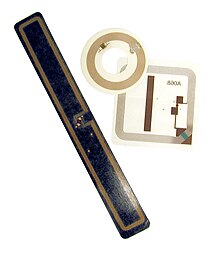
It is estimated that over 30 million library items worldwide now contain RFID tags, including some in the Vatican Library in Rome.
Since RFID tags can be read through an item, there is no need to open a book cover or DVD case to scan an item, and a stack of books can be read simultaneously.
Book tags can be read while books are in motion on a conveyor belt, which reduces staff time. This can all be done by the borrowers themselves, reducing the need for library staff assistance. With portable readers, inventories could be done on a whole shelf of materials within seconds.
However, as of 2008 this technology remains too costly for many smaller libraries, and the conversion period has been estimated at 11 months for an average-size library. A 2004 Dutch estimate was that a library which lends 100,000 books per year should plan on a cost of €50,000 (borrow- and return-stations: 12,500 each, detection porches 10,000 each; tags 0.36 each).
RFID taking a large burden off staff could also mean that fewer staff will be needed, resulting in some of them getting fired, but that has so far not happened in North America where recent surveys have not returned a single library that cut staff because of adding RFID.
In fact, library budgets are being reduced for personnel and increased for infrastructure, making it necessary for libraries to add automation to compensate for the reduced staff size. Also, the tasks that RFID takes over are largely not the primary tasks of librarians.
A finding in the Netherlands is that borrowers are pleased with the fact that staff are now more available for answering questions.
A concern surrounding RFID in issue of privacy. Because some RFID tags can be read from up to 100 meters (330 ft), there is some concern over whether sensitive information could be collected from an unwilling source. However, library RFID tags do not contain any patron information, and the tags used in the majority of libraries use a frequency only readable from approximately 10 feet (3.0 m).
Further, another non-library agency could potentially record the RFID tags of every person leaving the library without the library administrator's knowledge or consent. One simple option is to let the book transmit a code that has meaning only in conjunction with the library's database.
Another step further is to give the book a new code every time it is returned. And if in the future readers become ubiquitous (and possibly networked), then stolen books could be traced even outside the library. Tag removal could be made difficult if the tags are so small that they fit invisibly inside a (random) page, possibly put there by the publisher.
Museums
RFID technologies are now also implemented in end-user applications in museums. An example was the custom-designed temporary research application, "eXspot," at the Exploratorium, a science museum in San Francisco, California. A visitor entering the museum received an RF Tag that could be carried as a card. The eXspot system enabled the visitor to receive information about specific exhibits. Aside from the exhibit information, the visitor could take photographs of themselves at the exhibit. It was also intended to allow the visitor to take data for later analysis. The collected information could be retrieved at home from a "personalized" website keyed to the RFID tag.Schools and universities
School authorities in the Japanese city of Osaka are now chipping children's clothing, back packs, and student IDs in a primary school. A school in Doncaster, England is piloting a monitoring system designed to keep tabs on pupils by tracking radio chips in their uniforms. St Charles Sixth Form College in west London, England, started September, 2008, is using an RFID card system to check in and out of the main gate, to both track attendance and prevent unauthorized entrance.Similarly, Whitcliffe Mount School in Cleckheaton, England uses RFID to track pupils and staff in and out of the building via a specially designed card. In the Philippines, some schools already use RFID in IDs for borrowing books and also gates in those particular schools have RFID ID scanners for buying items at a school shop and canteen, library and also to sign in and sign out for student and teacher's attendance.
Sports


In the race, the racers wear tags that are read by antennae placed alongside the track or on mats across the track. UHF tags provide accurate readings with specially designed antennas. Rush error, lap count errors and accidents at start time are avoided since anyone can start and finish any time without being in a batch mode.
Passive and active RFID systems are used in off-road events such as Orienteering, Enduro and Hare and Hounds racing. Riders have a transponder on their person, normally on their arm. When they complete a lap they swipe or touch the receiver which is connected to a computer and log their lap time.
RFID is being adapted by many recruitment agencies which have a PET (Physical Endurance Test) as their qualifying procedure especially in cases where the candidate volumes may run into millions (Indian Railway Recruitment Cells, Police and Power sector).
A number of ski resorts have adopted RFID tags to provide skiers hands-free access to ski lifts. Skiers do not have to take their passes out of their pockets. Early on skiers were forced to use systems that required nearly contact - bending over to touch the turnstyles. These systems were based on high frequency (HF) at 13.56 megahertz. While effective at tracking the skiers they were difficult to use and expensive to deploy. However the bulk of ski areas in Europe, from Verbier to Chamonix use these systems.
Complement to barcode
RFID tags are often a complement, but not a substitute, for UPC or EAN barcodes. They may never completely replace barcodes, due in part to their higher cost and the advantage of multiple data sources on the same object. Also, unlike RFID labels, barcodes can be generated and distributed electronically, e.g. via e-mail or mobile phone, for printing or display by the recipient. An example is airline boarding passes. The new EPC, along with several other schemes, is widely available at reasonable cost.The storage of data associated with tracking items will require many terabytes. Filtering and categorizing RFID data is needed to create useful information. It is likely that goods will be tracked by the pallet using RFID tags, and at package level with Universal Product Code (UPC) or EAN from unique barcodes.
The unique identity is a mandatory requirement for RFID tags, despite special choice of the numbering scheme.
RFID tag data capacity is large enough that each individual tag will have a unique code, while current bar codes are limited to a single type code for a particular product.
The uniqueness of RFID tags means that a product may be tracked as it moves from location to location, finally ending up in the consumer's hands. This may help to combat theft and other forms of product loss. The tracing of products is an important feature that gets well supported with RFID tags containing a unique identity of the tag and also the serial number of the object.
This may help companies cope with quality deficiencies and resulting recall campaigns, but also contributes to concern about tracking and profiling of consumers after the sale.
It has also been proposed to use RFID for POS store checkout to replace the cashier with an automatic system which needs no barcode scanning. In the past this was not possible due to the higher cost of tags and existing POS process technologies. However, Industry Standard, a couture shop and recording studio in Ohio has successfully implemented a POS procedure that allows faster transaction throughput.
An FDA-nominated task force concluded, after studying the various technologies currently commercially available, which of those technologies could meet the pedigree requirements. Amongst all technologies studied including bar coding, RFID seemed to be the most promising and the committee felt that the pedigree requirement could be met by easily leveraging something that is readily available.
Telemetry
Active RFID tags also have the potential to function as low-cost remote sensors that broadcast telemetry back to a base station. Applications of tagometry data could include sensing of road conditions by implanted beacons, weather reports, and noise level monitoring.Passive RFID tags can also report sensor data. For example, the Wireless Identification and Sensing Platform is a passive tag that reports temperature, acceleration and capacitance to commercial Gen2 RFID readers.
It is possible that active or battery assisted passive (BAP) RFID tags, used with or in place of barcodes, could broadcast a signal to an in-store receiver to determine whether the RFID tag (product) is in the store.
Mandates
Wall-Mart and the United States Department of Defense have published requirements that their vendors place RFID tags on all shipments to improve supply chain management. Due to the size of these two organizations, their RFID mandates impact thousands of companies worldwide. The deadlines have been extended several times because many vendors face significant difficulties implementing RFID systems. In practice, the successful read rates currently run only 80%, due to radio wave attenuation caused by the products and packaging. In time it is expected that even small companies will be able to place RFID tags on their outbound shipments.Wal-Mart

An EPC RFID tag used by Wal-Mart.
In October 2005 the University of Arkansas' Information Technology Research Institute released a report on its preliminary study of the impact of RFID on reducing retail out-of-stocks and concluded that RFID reduced out of stocks (OOS) by 21% over non-RFID based stores.
Two years later the Wall Street Journal published an article titled "Wal-Mart's Radio-Tracked Inventory Hits Static." The articles stated that the RFID plan set forth by Wal-Mart was "showing signs of fizzling" due to a lack of progress by Wal-Mart executives to introduce the technology to its stores and to the lack of incentives for suppliers.